
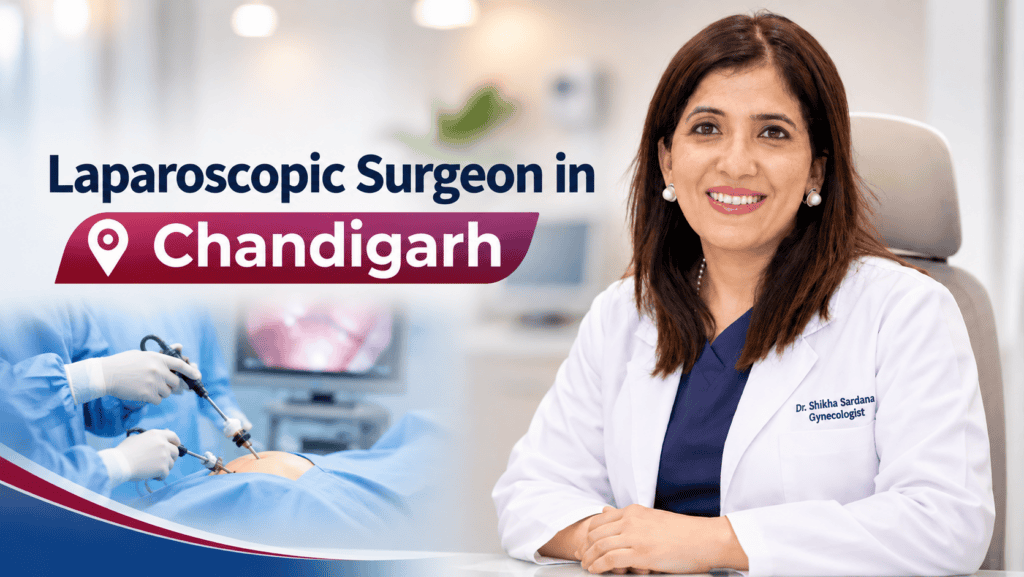
Not long ago, most gynecological operations meant a large cut on the abdomen, a week in hospital and several weeks off work. Today, most of these surgeries can be done through keyhole incisions of 5 to 10 mm with laparoscopy, or with no cut at all through hysteroscopy.
As a gynecologist, fertility specialist and laparoscopic surgeon in Chandigarh, I perform these procedures for fibroids, ovarian cysts, endometriosis, ectopic pregnancy, infertility and hysterectomy. This guide explains when laparoscopy is needed, what to expect, recovery times and how to choose the right surgeon.
A gynecologic laparoscopic surgeon treats conditions of the uterus, ovaries and tubes through small keyhole cuts using a camera. Common procedures include removal of ovarian cysts, fibroids (myomectomy), endometriosis surgery, ectopic pregnancy surgery, tubal surgery and laparoscopic hysterectomy. Compared with open surgery, laparoscopy usually means less pain, smaller scars, a shorter hospital stay of about one day, and a return to normal activity in about one to two weeks.
Laparoscopy and Hysteroscopy Explained
Laparoscopy (keyhole surgery)
Under general anesthesia, a thin telescope with a camera is passed through a small cut near the navel. The abdomen is gently filled with carbon dioxide so the organs can be seen clearly on a magnified screen, and fine instruments are inserted through two or three other small cuts.
Hysteroscopy (no cut)
A slim telescope is passed through the vagina and cervix into the uterus. It is used to see and treat problems inside the uterine cavity, usually as a day-care procedure.
Conditions Treated with Laparoscopy and Hysteroscopy
| Condition | Procedure |
|---|---|
| Ovarian cysts and endometriomas | Laparoscopic ovarian cystectomy, preserving healthy ovarian tissue |
| Fibroids in the uterine wall | Laparoscopic myomectomy |
| Fibroids or polyps inside the cavity | Hysteroscopic myomectomy or polypectomy |
| Endometriosis | Laparoscopic excision or ablation and adhesiolysis |
| Ectopic pregnancy | Laparoscopic salpingostomy or salpingectomy |
| Infertility and blocked tubes | Diagnostic laparoscopy with dye test, adhesiolysis, hydrosalpinx surgery |
| PCOS not responding to medicines | Laparoscopic ovarian drilling |
| Uterine septum or adhesions | Hysteroscopic septum resection or adhesiolysis |
| Heavy bleeding, large fibroids, adenomyosis | Laparoscopic hysterectomy when childbearing is complete |
| Permanent contraception | Laparoscopic tubal ligation |
For the full list of procedures, see laparoscopy and hysteroscopy in Chandigarh. Fibroids and endometriosis are explained in endometriosis and fibroids, and tubal problems in blocked fallopian tubes treatment.
Benefits of Laparoscopy over Open Surgery
Smaller cuts
Three or four small incisions instead of one long scar.
Less pain
Most women need only simple painkillers after surgery.
Shorter stay
Usually same-day or next-day discharge.
Faster recovery
Back to routine activities in about one to two weeks for many procedures.
Better view
Magnified, high-definition view helps precise surgery and preserves healthy tissue.
Fertility-friendly
Fewer adhesions, which matters for women who want to conceive.
Advised Gynecologic Surgery?
Get an expert opinion from Dr. Shikha Sardana, laparoscopic surgeon and gynecologist in Chandigarh.
Your Laparoscopic Surgery Journey, Step by Step
- Consultation and scans: examination, ultrasound and sometimes MRI to plan the surgery.
- Pre-operative tests: blood tests, ECG and an anesthesia check-up.
- Preparation: fasting for about 6 to 8 hours and instructions on your regular medicines.
- Surgery day: the procedure is done under anesthesia; most take 30 minutes to 2 hours depending on complexity.
- Recovery and discharge: you walk the same day and most women go home within 24 hours.
- Follow-up: a review visit in 7 to 10 days to check healing and discuss reports.
Recovery Time After Gynecologic Laparoscopy
| Procedure | Typical hospital stay | Return to desk work |
|---|---|---|
| Diagnostic hysteroscopy or laparoscopy | Day care | 1 to 3 days |
| Ovarian cystectomy, ectopic surgery | About 1 day | About 1 week |
| Laparoscopic myomectomy | 1 to 2 days | About 2 weeks |
| Laparoscopic hysterectomy | 1 to 2 days | About 2 to 3 weeks |
Mild shoulder-tip pain from the gas and some bloating are common for a day or two. Avoid heavy lifting for a few weeks and follow your surgeon’s advice on exercise and intercourse.
Laparoscopy and Fertility
For women trying to conceive, the surgeon’s approach matters as much as the operation. Removing a cyst while protecting healthy ovarian tissue, treating endometriosis without lowering AMH unnecessarily, and preventing adhesions all affect future fertility. Because Dr. Shikha Sardana is also an infertility specialist in Chandigarh, surgery is planned with your fertility goals and, if needed, IVF in mind. Read about low AMH and PCOS treatment.
How to Choose a Laparoscopic Surgeon in Chandigarh
- Specialist training in gynecology with regular hands-on laparoscopic and hysteroscopic experience
- Surgery in a well-equipped hospital with good anesthesia support
- A clear explanation of why surgery is needed and of non-surgical alternatives
- Fertility-preserving techniques for younger women
- Transparent costs and personal follow-up after surgery
Dr. Shikha Sardana, an alumna of PGIMER Chandigarh with 16+ years of experience, is a gynecologic laparoscopic surgeon in Chandigarh and is recognised by many patients as the best gynecologist in Chandigarh. Women from Mohali, Panchkula, Zirakpur, Kharar, Rupnagar and Himachal consult her for keyhole surgery. Read patient reviews on her laparoscopic surgeon in Chandigarh Google Business Profile.
Frequently Asked Questions
What does a gynecologic laparoscopic surgeon do?
A gynecologic laparoscopic surgeon treats conditions of the uterus, ovaries and fallopian tubes through small keyhole cuts, including ovarian cysts, fibroids, endometriosis, ectopic pregnancy, tubal problems and hysterectomy.
Is laparoscopy a major surgery?
Laparoscopy is done under general anesthesia, so it is taken seriously, but it is much less invasive than open surgery. Most women go home within a day and recover within one to two weeks.
How long does it take to recover after laparoscopy?
Recovery depends on the procedure. Diagnostic laparoscopy takes a few days, cyst removal about a week, and myomectomy or hysterectomy about two to three weeks before returning to desk work.
Can fibroids be removed by laparoscopy?
Yes. Most fibroids can be removed laparoscopically (myomectomy) and fibroids inside the cavity can be removed hysteroscopically. Very large or numerous fibroids may sometimes need open surgery.
Can I get pregnant after laparoscopic surgery?
Yes. Many laparoscopic procedures such as treating endometriosis, removing cysts, fibroids or adhesions are done to improve fertility. Your surgeon will advise how long to wait before trying.
What is the difference between laparoscopy and hysteroscopy?
Laparoscopy looks at the outside of the uterus, ovaries and tubes through small cuts in the abdomen. Hysteroscopy looks inside the uterus through the vagina and cervix with no cuts.
Who is a good laparoscopic surgeon for gynecology in Chandigarh?
Choose a gynecologist with regular laparoscopic experience, good hospital support and a fertility-preserving approach. Dr. Shikha Sardana offers gynecologic laparoscopy and hysteroscopy for women from Chandigarh, Mohali and Panchkula.
Keyhole Surgery with Expert, Personal Care
Book a consultation with Dr. Shikha Sardana, gynecologic laparoscopic surgeon in Chandigarh.
You can consult Dr. Shikha Sardana at Vivant Clinic, SCO 290/1, Sector 32D, Chandigarh, or at Milann Fertility Centre, Sector 46-A, Chandigarh, Monday to Saturday by appointment. Visit the laparoscopic surgeon in Chandigarh on Google Maps.
This article is for general awareness and does not replace a personal medical consultation. Treatment plans, costs and outcomes vary from person to person.