
“Should we try IUI first, or go straight to IVF?” This is one of the most common questions I am asked during consultations in Chandigarh. Friends, relatives and the internet often give conflicting advice, and couples end up confused about terms like IUI, IVF and ICSI.
In this guide I explain each treatment in simple language, who it suits, typical success rates, approximate costs, and how we decide the right option for you. If you are planning fertility treatment in Chandigarh, this comparison will help you have a more confident conversation with your doctor.
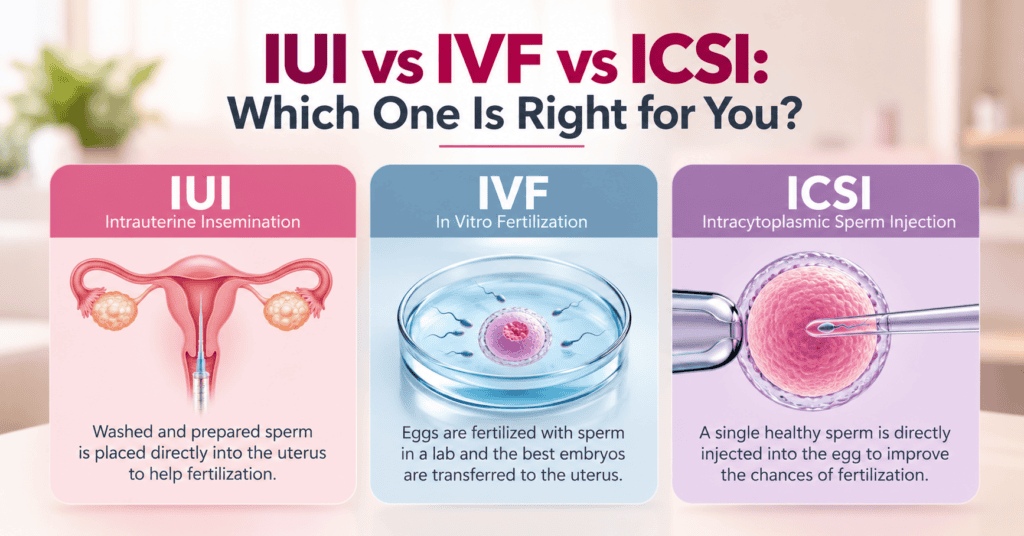
IUI places washed sperm directly into the uterus and suits younger women with open tubes and mild male factor or unexplained infertility. IVF fertilises eggs outside the body and suits blocked tubes, low egg reserve, endometriosis or failed IUI. ICSI is a type of IVF where one sperm is injected into each egg, mainly for severe male factor infertility. The right choice depends on age, tubes, egg reserve and sperm quality, not on cost alone.
What Is IUI (Intrauterine Insemination)?
IUI is a simple, painless OPD procedure. The husband’s semen sample is washed and concentrated in the lab, and the best sperm are placed directly into the uterus through a thin catheter around the time of ovulation. It takes a few minutes and you can go back to work the same day.
Who is IUI suitable for?
- Women generally under 35 to 37 with at least one open fallopian tube
- Mild male factor (slightly low count or motility)
- Unexplained infertility
- Ovulation problems such as PCOS, combined with ovulation induction
- Couples with intercourse difficulties or cervical factor
- IUI with donor sperm when needed
IUI success rate and cost
Success rates for IUI are commonly quoted at around 10 to 20% per cycle, higher in younger women and lower after 38. Most specialists suggest 3 to 4 cycles before moving on. The procedure itself is affordable, usually in the range of a few thousand to around ₹10,000 to ₹15,000 per cycle in Chandigarh, plus medicines and scans.
What Is IVF (In Vitro Fertilisation)?
In IVF, the ovaries are stimulated with injections to produce several eggs. The eggs are collected in a short procedure under anesthesia, fertilised with sperm in the embryology lab, and the best embryo is transferred into the uterus after 3 to 5 days. Extra good embryos can be frozen for future use.
Who is IVF suitable for?
- Blocked or damaged fallopian tubes
- Low AMH or reduced egg reserve (see our low AMH guide)
- Moderate to severe endometriosis
- Women above 37 to 38 who cannot afford to lose time
- Three to four failed IUI cycles
- Couples wanting embryo freezing or genetic testing
IVF success rate and cost
IVF success depends strongly on the woman’s age and embryo quality. Per-transfer pregnancy rates are generally much higher than IUI, especially under 35, and decline with age. A standard cycle in Chandigarh typically costs ₹1.4 lakh to ₹2.25 lakh at our centre. See the full IVF cost in Chandigarh breakdown.
Not Sure Whether IUI or IVF Is Right for You?
Get a personalised recommendation from Dr. Shikha Sardana after reviewing your reports.
What Is ICSI (Intracytoplasmic Sperm Injection)?
ICSI is an advanced form of IVF. Instead of placing eggs and sperm together in a dish, the embryologist picks a single healthy sperm and injects it directly into each mature egg. Everything else, stimulation, egg collection and embryo transfer, is the same as IVF.
Who needs ICSI?
- Very low sperm count, poor motility or abnormal shape
- Zero sperm in semen, where sperm are retrieved surgically through PESA or TESA
- Poor or failed fertilisation in a previous IVF cycle
- Frozen sperm or a limited number of eggs
ICSI adds an extra lab charge. If sperm parameters are normal, conventional IVF is often equally effective, so ICSI should be advised for a reason. Male partners can learn more in our article on andrology and male fertility.
IUI vs IVF vs ICSI: Side-by-Side Comparison
| Feature | IUI | IVF | ICSI |
|---|---|---|---|
| Where fertilisation happens | Inside the body | In the lab | In the lab, sperm injected into egg |
| Tubes need to be open? | Yes | No | No |
| Best for | Mild male factor, unexplained, PCOS | Tube block, low AMH, endometriosis, failed IUI | Severe male factor, failed fertilisation |
| Procedure | OPD, few minutes, painless | Injections, egg pick-up under anesthesia, transfer | Same as IVF plus micro-injection |
| Typical success | About 10 to 20% per cycle | Higher; depends on age and embryo quality | Similar to IVF when used for the right reason |
| Approximate cost | Low | Moderate to high | IVF cost plus ICSI charge |
How Do We Decide the Right Treatment for You?
There is no single “best” treatment. We decide based on four key factors:
- The woman’s age: after 37 to 38, moving to IVF sooner is often wiser.
- Tubal status: blocked tubes mean IUI will not work.
- Egg reserve: AMH and antral follicle count guide the urgency.
- Sperm quality: normal, mildly reduced or severely reduced decides IUI, IVF or ICSI.
Duration of infertility, previous treatments, finances and your personal preferences also matter. A good plan respects all of these.
Common Myths About IUI and IVF
- “IVF babies are not normal.” Babies born through IVF and ICSI are healthy children. Millions have been born worldwide since 1978.
- “IUI is a waste of time.” For the right couple, IUI is effective and far more affordable.
- “IVF always means twins.” Transferring a single good embryo greatly reduces the chance of twins.
- “IVF requires full bed rest.” Most women return to normal routine within a day or two after transfer. Stress management matters more; see managing your mind during IVF.
Frequently Asked Questions
What is the difference between IUI and IVF?
In IUI, washed sperm is placed inside the uterus and fertilisation happens naturally in the tube. In IVF, eggs are collected and fertilised in the lab, and the embryo is transferred into the uterus. IVF is more complex but has higher success per attempt.
Should I try IUI before IVF?
Often yes, if you are under about 35 to 37, have at least one open tube and the sperm count is near normal. If tubes are blocked, egg reserve is low or sperm count is very low, going directly to IVF or ICSI is usually better.
How many IUI cycles should I try before IVF?
Most specialists suggest 3 to 4 IUI cycles. If pregnancy does not occur, IVF is usually the next step because further IUI cycles rarely add much benefit.
Is ICSI better than IVF?
ICSI is not automatically better. It is the preferred method for male factor infertility or previous fertilisation failure. When sperm quality is normal, conventional IVF gives similar results.
Is IUI painful?
No. IUI feels similar to a routine pelvic examination or Pap test and takes only a few minutes. Most women go back to normal activities the same day.
Where can I get IUI and IVF treatment in Chandigarh?
Dr. Shikha Sardana offers IUI, IVF and ICSI for couples from Chandigarh, Mohali and Panchkula, with consultations at Sector 32D and Sector 46-A, Chandigarh.
Find the Right Fertility Treatment, Step by Step
Book a consultation for IUI, IVF or ICSI in Chandigarh with Dr. Shikha Sardana.
You can consult Dr. Shikha Sardana at Vivant Clinic, SCO 290/1, Sector 32D, Chandigarh, or at Milann Fertility Centre, Sector 46-A, Chandigarh, Monday to Saturday by appointment. Locate the IUI and IVF centre in Chandigarh on Google Maps.
This article is for general awareness and does not replace a personal medical consultation. Treatment plans, costs and outcomes vary from person to person.