
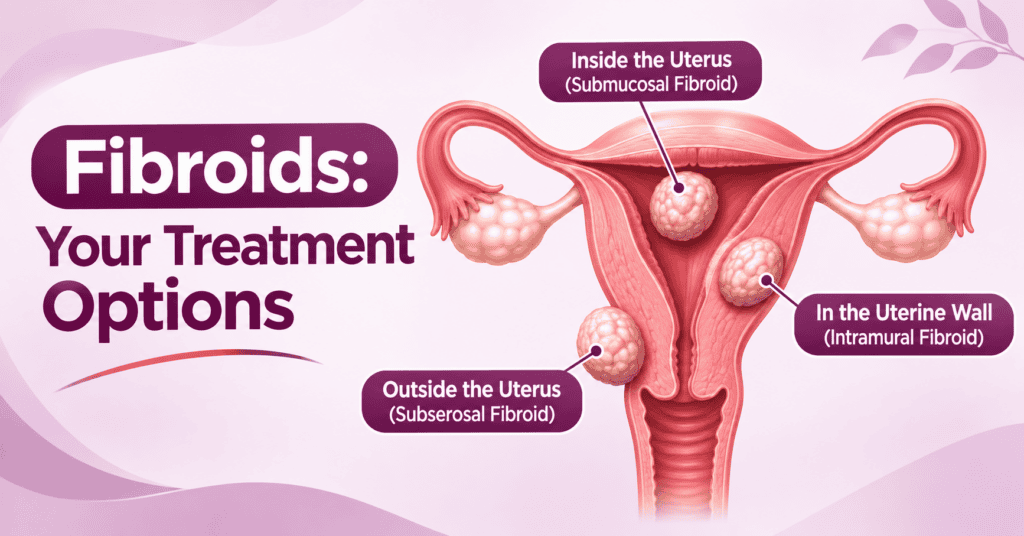
“My ultrasound says fibroid. Do I need an operation?” This is one of the most common questions I hear from women in my Chandigarh clinic. Fibroids are extremely common, and the word alone often causes needless fear about cancer, hysterectomy or never being able to conceive.
The truth is reassuring. Fibroids are almost always non-cancerous, many need no treatment at all, and today there are options ranging from tablets to keyhole surgery that protect the uterus. In this guide I explain fibroid symptoms, types, when treatment is needed and every option available, so you can make an informed choice with your gynecologist in Chandigarh.
Uterine fibroids are non-cancerous growths of the uterine muscle that affect a large majority of women by age 50. Small fibroids without symptoms usually need only monitoring. Fibroids causing heavy bleeding, pain, pressure or fertility problems can be treated with medicines, hysteroscopic removal (for fibroids inside the cavity), laparoscopic myomectomy (keeping the uterus), image-guided procedures such as uterine artery embolisation, or hysterectomy when family is complete. The right choice depends on the fibroid’s size and location, your symptoms, age and pregnancy plans.
What Are Uterine Fibroids?
Fibroids (also called myomas or leiomyomas) are firm, round growths of the muscle wall of the uterus. They can be as small as a seed or larger than a melon, single or many. Their growth is driven by the hormones oestrogen and progesterone, which is why they often grow during the reproductive years and usually shrink after menopause.
Fibroids are not cancer, and they very rarely turn into cancer. Rapid growth after menopause is unusual and should always be checked.
Types of Fibroids: Location Matters Most
Submucosal
Bulge into the uterine cavity. Cause heavy bleeding and affect fertility even when small. Usually removed by hysteroscopy.
Intramural
Inside the muscle wall. Large ones may cause heavy periods, pain or affect implantation.
Subserosal
Grow on the outer surface. Can cause pressure on the bladder or bowel but rarely affect periods.
Pedunculated
Attached by a stalk, inside or outside the uterus. Can twist and cause sudden pain.
Common Fibroid Symptoms
- Heavy or prolonged periods, passing clots
- Anaemia, tiredness and breathlessness from blood loss
- Pelvic pain, painful periods or pain during intercourse
- Frequent urination or constipation due to pressure
- A swelling or heaviness in the lower abdomen
- Difficulty conceiving or repeated miscarriage in some cases
Many women have no symptoms at all and discover fibroids only on a routine ultrasound.
Diagnosed with Fibroids?
Get an expert opinion on whether you need treatment from Dr. Shikha Sardana, gynecologist in Chandigarh.
Do All Fibroids Need Treatment?
No. Size alone is not the deciding factor. Treatment is usually advised when there is:
| Situation | Usual approach |
|---|---|
| Small fibroid, no symptoms | Monitor with ultrasound every 6 to 12 months |
| Heavy periods or anaemia | Medicines first; procedure if not controlled |
| Submucosal fibroid and infertility or miscarriage | Hysteroscopic removal |
| Large or growing fibroid with pain or pressure | Laparoscopic myomectomy or other uterus-sparing option |
| Family complete, severe symptoms | Laparoscopic hysterectomy may be discussed |
| Rapid growth or after menopause | Further imaging and specialist assessment |
Fibroid Treatment Options in Chandigarh
1. Medicines
Tranexamic acid and pain relievers reduce bleeding and cramps. Hormonal treatment, including the progesterone-releasing intrauterine system (hormonal IUD) and certain tablets, can control heavy periods. GnRH-based medicines shrink fibroids temporarily and are often used before surgery to correct anaemia. Medicines control symptoms but do not remove fibroids, and fibroids may regrow after stopping.
2. Hysteroscopic myomectomy (no cut)
Fibroids inside the cavity are removed through the vagina with a hysteroscope, usually as day care. This is one of the most effective procedures for women with fibroid-related infertility or heavy bleeding.
3. Laparoscopic myomectomy (keyhole, uterus preserved)
Fibroids in the wall or on the surface are removed through small cuts and the uterus is carefully repaired. It suits women who want to keep their uterus or plan a pregnancy. Read more in our guide to the laparoscopic surgeon in Chandigarh.
4. Image-guided procedures (without surgery)
Uterine artery embolisation (UAE), done by an interventional radiologist, blocks the blood supply to fibroids so they shrink. Radiofrequency or microwave ablation and MRI-guided focused ultrasound destroy fibroid tissue with heat. These are good options for selected women who want to avoid surgery, but they are not suitable for every fibroid, and evidence on future pregnancy is still more limited than for myomectomy. We discuss these and refer to trusted colleagues when they fit your case.
5. Hysterectomy
Removing the uterus is the only permanent cure and is considered when a woman has completed her family and other treatments have not helped. It is done laparoscopically in most cases. It is never the only choice, and you should always be told about alternatives.
Fibroids, Fertility and Pregnancy
Many women with fibroids conceive naturally and have normal pregnancies. Fibroids are more likely to affect fertility when they distort the uterine cavity (submucosal) or are large intramural fibroids. Removing such fibroids before trying, or before IVF, can improve the chance of implantation. Read about how this fits into IVF success rates and recurrent miscarriage treatment.
During pregnancy, fibroids may grow and occasionally cause pain or affect the baby’s position. They are monitored with regular scans; see high-risk pregnancy care. After a myomectomy, your doctor will advise how long to wait before trying to conceive and whether a caesarean is recommended.
Fibroids vs Adenomyosis vs Endometriosis
These three conditions can all cause heavy, painful periods and are sometimes confused. Fibroids are distinct lumps, adenomyosis is a diffuse thickening of the uterine wall, and endometriosis involves tissue outside the uterus. Treatment differs, so an accurate ultrasound or MRI diagnosis is important. Read endometriosis and fibroids.
Fibroid Treatment with Dr. Shikha Sardana
Dr. Shikha Sardana is a gynecologist, fertility specialist and laparoscopic surgeon in Chandigarh. Because she also works in IVF as an infertility specialist, she plans fibroid treatment with your pregnancy goals in mind, choosing uterus-sparing options wherever possible. Women from Mohali, Panchkula, Zirakpur and Kharar consult her for a second opinion before surgery. Read reviews and get directions on her fibroid treatment in Chandigarh Google Business Profile.
Frequently Asked Questions About Fibroids
Can fibroids be treated without surgery?
Yes. Many fibroids are managed with monitoring or medicines. Image-guided procedures such as uterine artery embolisation and radiofrequency ablation are non-surgical options for selected women.
What size of fibroid needs surgery?
There is no single size cut-off. Treatment depends on symptoms, location and fertility plans. A small submucosal fibroid may need removal, while a larger fibroid on the outer surface without symptoms may only be watched.
Can I get pregnant with fibroids?
Yes, many women do. Fibroids that distort the cavity or are large may reduce fertility and can be removed before trying or before IVF.
Do fibroids come back after removal?
New fibroids can develop after myomectomy, especially in younger women with many fibroids. Hysterectomy is the only treatment that prevents recurrence completely.
Can fibroids turn into cancer?
Fibroids are benign and very rarely become cancerous. Rapid growth, especially after menopause, needs further evaluation.
Do fibroids shrink after menopause?
Yes, most fibroids shrink after menopause as hormone levels fall, so women close to menopause with mild symptoms may be able to avoid surgery.
Where can I get fibroid treatment in Chandigarh?
Dr. Shikha Sardana offers fibroid evaluation, medical treatment, hysteroscopic and laparoscopic myomectomy and laparoscopic hysterectomy at Sector 32D and Sector 46-A, Chandigarh.
Explore All Your Fibroid Treatment Options
Consult Dr. Shikha Sardana, gynecologist and laparoscopic surgeon in Chandigarh, before deciding on surgery.
You can consult Dr. Shikha Sardana at Vivant Clinic, SCO 290/1, Sector 32D, Chandigarh, or at Milann Fertility Centre, Sector 46-A, Chandigarh, Monday to Saturday by appointment. Visit the best gynecologist in Chandigarh on Google Maps.
This article is for general awareness and does not replace a personal medical consultation. Treatment plans, costs and outcomes vary from person to person.